
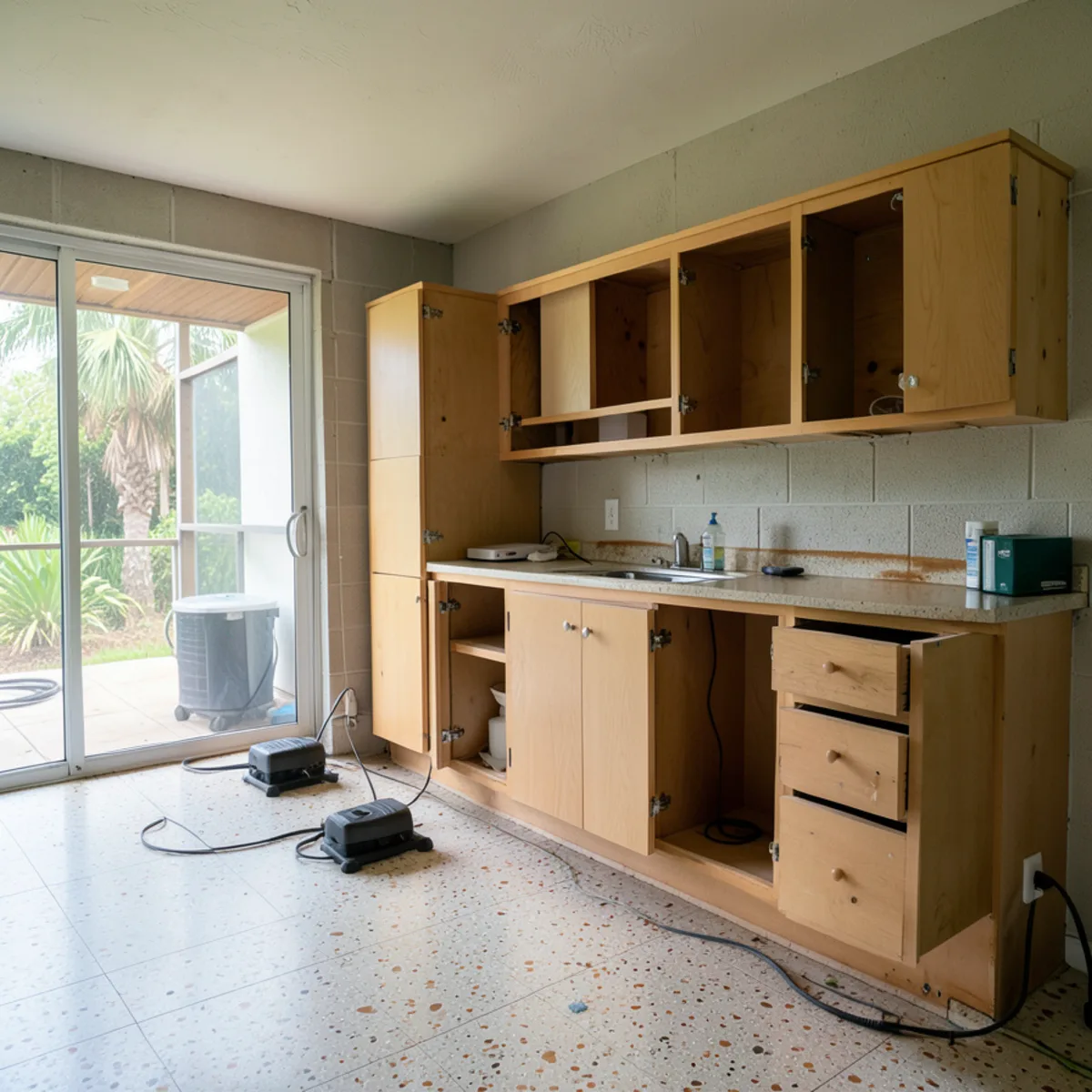
Make the house safe, photograph every surface before anything is thrown out, and get water and wet material out of the kitchen within a day or two so the walls and subfloor behind the cabinets can dry. With flood damaged kitchen cabinets, what to do comes down to those three steps, in that order.
Southwest Florida learned this the hard way in recent seasons. Hurricane Helene pushed surge into ground-level homes on Anna Maria Island, Longboat Key and Manasota Key in September 2024, and Hurricane Milton came ashore near Siesta Key two weeks later. This guide walks through the first days after the water recedes, from documentation to the point where new cabinets can be measured.
Flood-Damaged Kitchen Cabinets: What to Do in the First 48 Hours
The EPA’s mold guidance is clear on timing: wet building materials and furnishings should be cleaned and dried within 24–48 hours to limit mold growth. Cabinets sit right on the floor, so they are usually the last thing to dry and the first thing to grow mold. These steps keep your options open.
- 1
Confirm it is safe to enter
Wait for local officials to clear your street. If water touched outlets or the panel, leave the power off and have an electrician check it before you turn breakers back on.
- 2
Photograph before you touch anything
Shoot wide views of the room, then close-ups of the waterline, swollen cabinet bottoms, the toe kicks and inside every base cabinet. Video with narration works well too.
- 3
Report the loss
Call your flood insurer and your homeowners insurer, note the claim numbers and ask what they want kept for inspection.
- 4
Empty and open everything
Pull drawers, open doors, remove shelves and get dishes and food out. Floodwater is contaminated, so anything porous it touched is suspect.
- 5
Start drying the room
Remove standing water, run fans and a dehumidifier if power is safe, and open windows when outdoor air is drier than indoor air.
Need the kitchen measured once it is dry? Call (239) 545-0550 and we will set up a technical visit.
Call (239) 545-0550Why Does Storm Surge Kitchen Damage Hit Cabinets So Hard?
Storm surge is not clean rainwater. It carries salt, silt, sewage and fuel, and it often sits in a house for hours. Most kitchen cabinet boxes are built from particleboard or MDF, which soaks water up through cut edges like a sponge and does not shrink back once it swells.
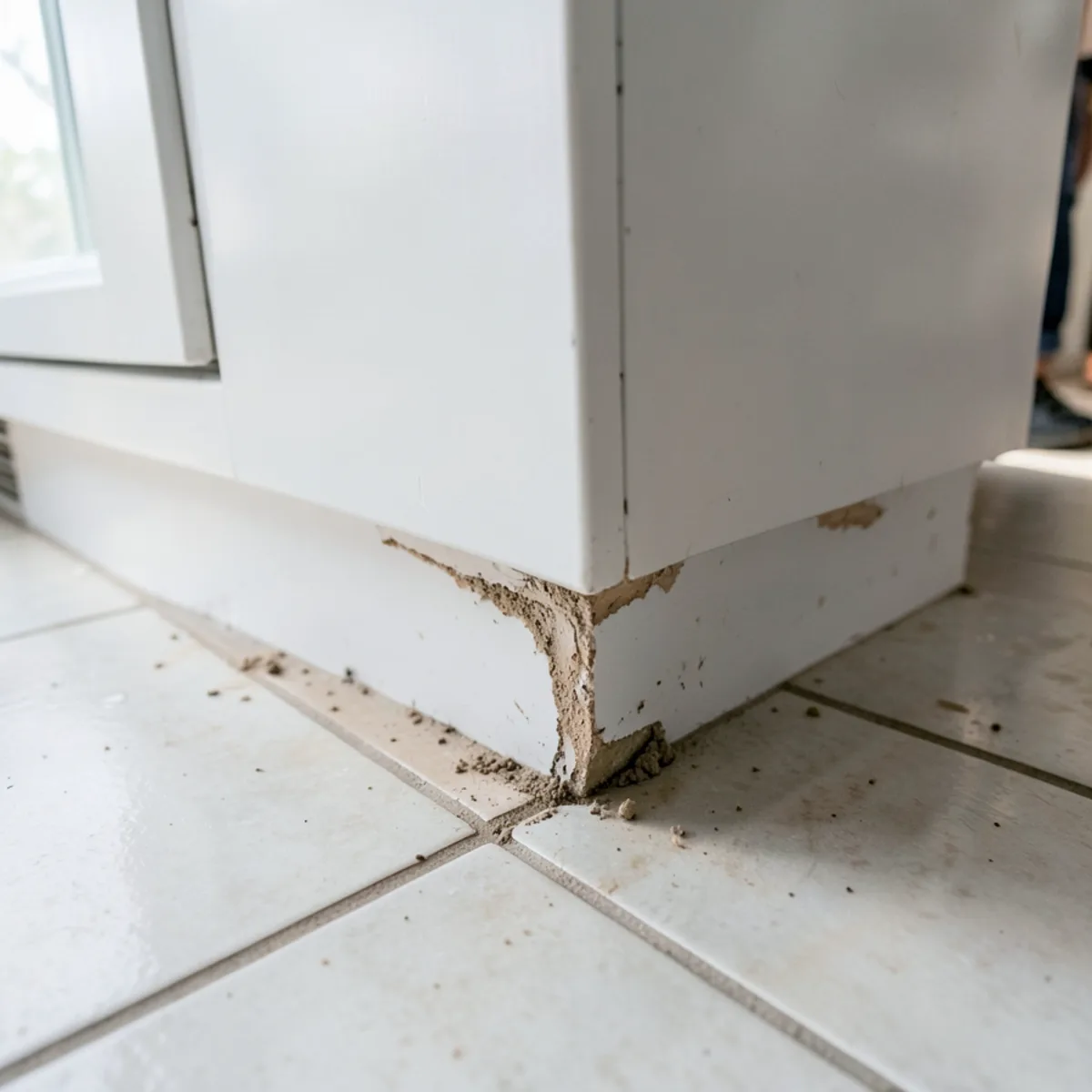
- The toe kick and cabinet bottom absorb water first and hide it from view.
- Side panels and back panels wick water upward, often several inches above the visible waterline.
- The wall cavity behind the cabinets holds wet drywall and insulation that cannot dry while the cabinets are in place.
- Hinges, slides and screws corrode quickly in salt water, even when the wood looks fine.
That last point matters on barrier islands. On Siesta Key and in Holmes Beach, where many ground-level homes took on salt water in 2024, hardware failure can show up weeks after the boxes seemed to dry.
How Should You Document Damage for Insurance?
Your adjuster decides what the policy pays for, and they can only judge what they can see. Good records also help when undamaged upper cabinets no longer match replacements, a question we cover in our post on whether insurance covers water-damaged cabinets.
- Measure the waterline height with a tape measure in the photo, at several walls.
- Keep a sample of the damaged material: a cabinet door, a drawer front or a cut piece of side panel, bagged and labeled.
- Photograph the inside label or stamp of each cabinet if there is one, along with appliance model plates.
- Save receipts for fans, dehumidifiers, mitigation services and any temporary repairs.
We are not adjusters and cannot predict what a claim will pay. What we can provide, once the room is measured, is a written cabinet scope and a 3D plan you can share with your adjuster or your own advisors.
What Can You Keep From Flooded Kitchen Drawers and Pantry Shelves?
Everything inside the cabinets has to be sorted before the boxes come out, and the USDA Food Safety and Inspection Service treats floodwater as contaminated, so its rules are strict.
- Throw out any food floodwater touched unless it is in an undamaged all-metal commercial can or retort pouch; jars with screw caps or snap lids and anything home-canned go too.
- Throw out wooden cutting boards and spoons, plastic utensils, baby bottle nipples and pacifiers, which USDA says cannot be safely cleaned.
- Clean and keep metal pans, ceramic dishes and glassware: wash them in hot soapy water, then sanitize by boiling in clean water or soaking for 15 minutes in 1 tablespoon of unscented liquid chlorine bleach per gallon of drinking water.
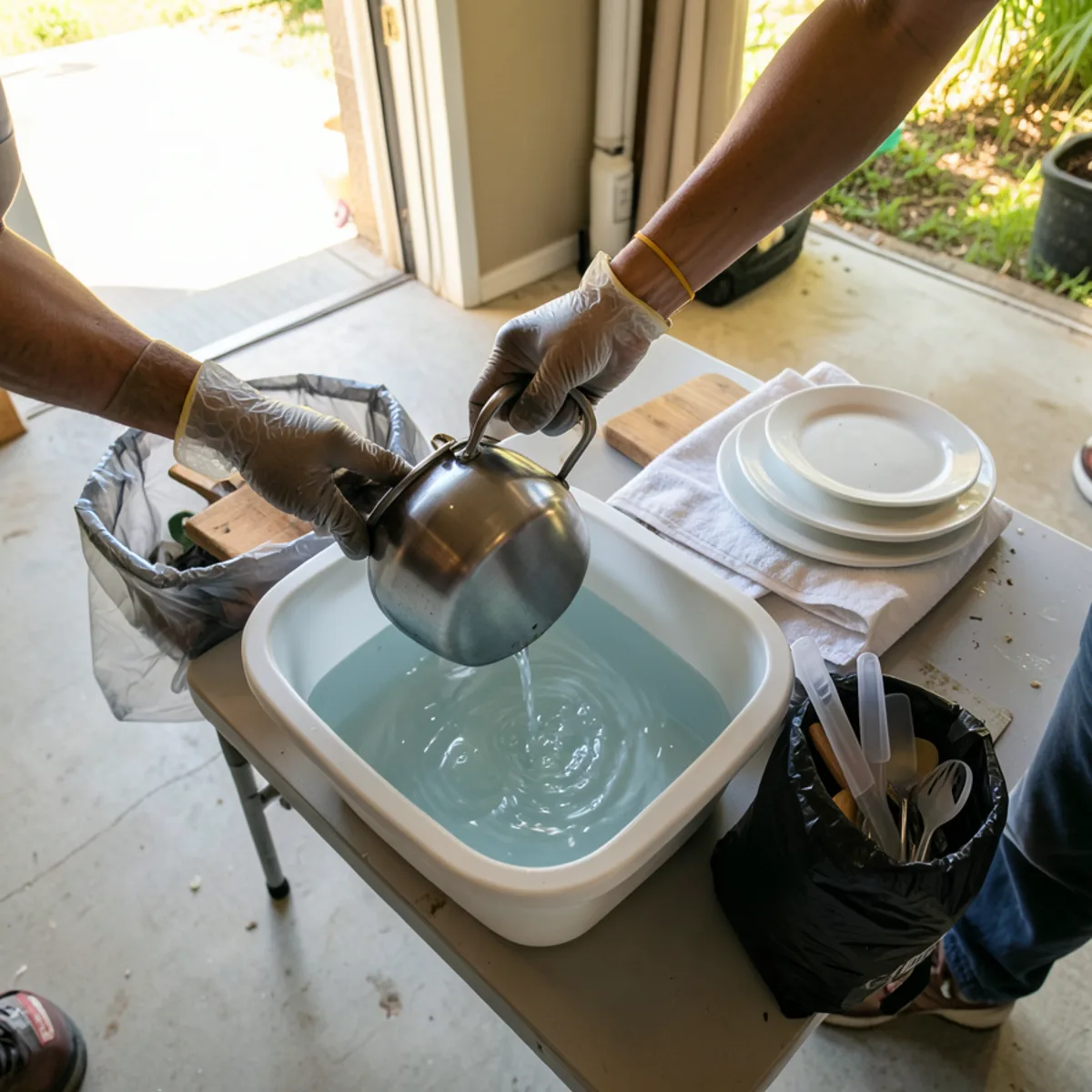
Photograph what you discard. Food, dishes and small appliances count as contents, and FloodSmart notes that an NFIP flood policy covers contents only when contents coverage was purchased separately.
Should You Remove Wet Cabinets Yourself?
Ask your insurer first, and once they have documented the room, removal is usually the right call for base cabinets that sat in floodwater. The table shows how different parts of a flooded kitchen typically fare.
| Component | Usual outcome | Why |
|---|---|---|
| Particleboard or MDF base cabinets | Replace | Swelling is permanent and contaminated water soaks into the core |
| Upper (wall) cabinets above the waterline | Often kept, after inspection | They may be dry, but matching new base cabinets can be difficult |
| Granite or quartz countertops | Sometimes reused | The stone survives water; careful removal is the risk |
| Drywall and insulation behind cabinets | Cut out above the waterline | Wet wall cavities hold moisture and grow mold |
| Appliances that sat in water | Have them inspected | Electrical and gas components can be unsafe |
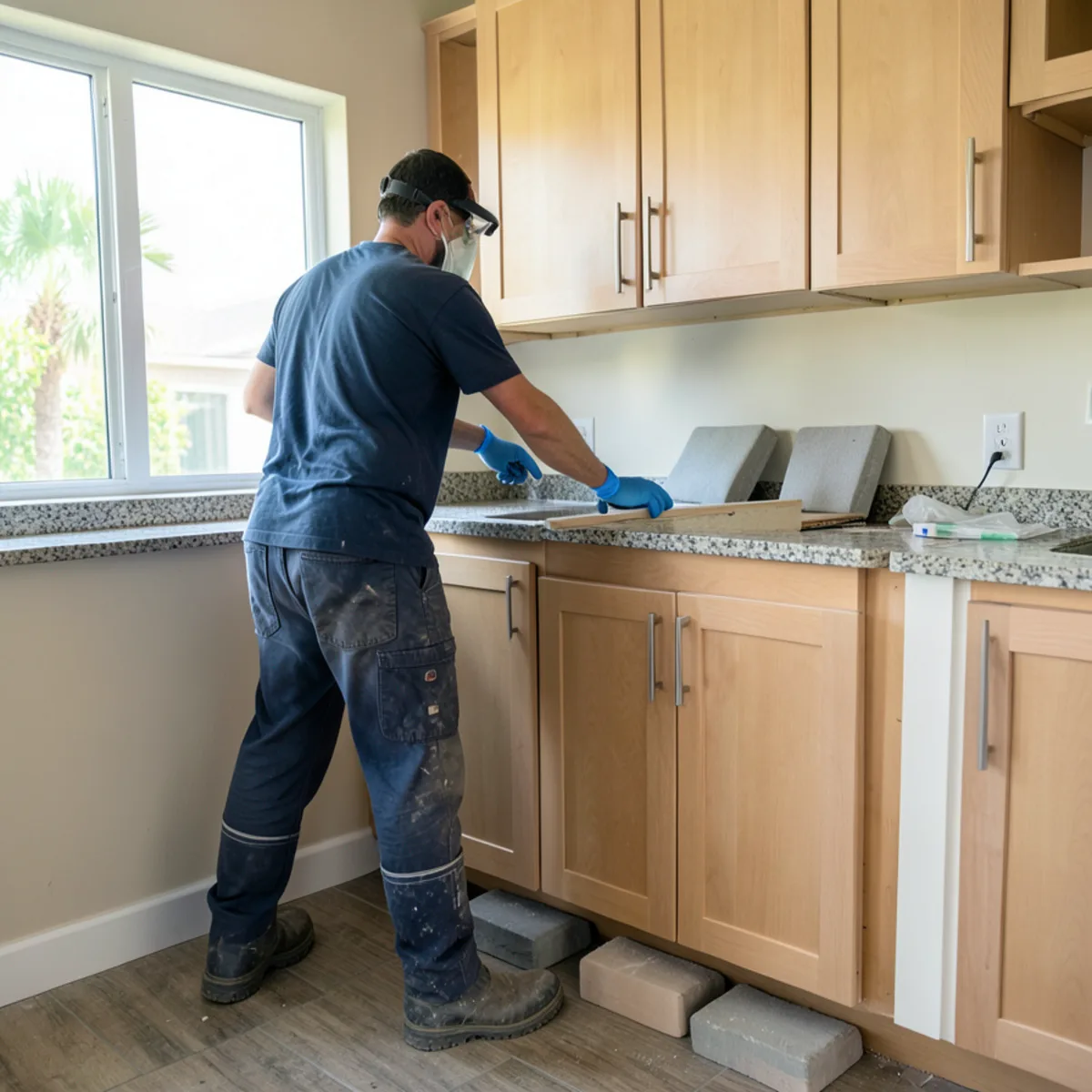
If you remove cabinets yourself, wear gloves, boots and an N95 respirator, as the EPA recommends for flood cleanup, and lift the countertop off first so the stone does not crack when the boxes give way.
Kitchen Flood Cleanup in Florida: When Is the Room Ready for New Cabinets?
New cabinets should go onto a dry slab against dry, repaired walls. A mitigation company or contractor can take moisture readings to confirm it. Installing early traps moisture behind brand-new boxes and repeats the problem.
Badly damaged homes may face another step. FEMA’s substantial improvement rule, administered by your local floodplain administrator, can require a home in a flood zone to be brought up to current flood standards when repair costs reach 50 percent of the structure’s market value. Ask your building department before you plan the rebuild.
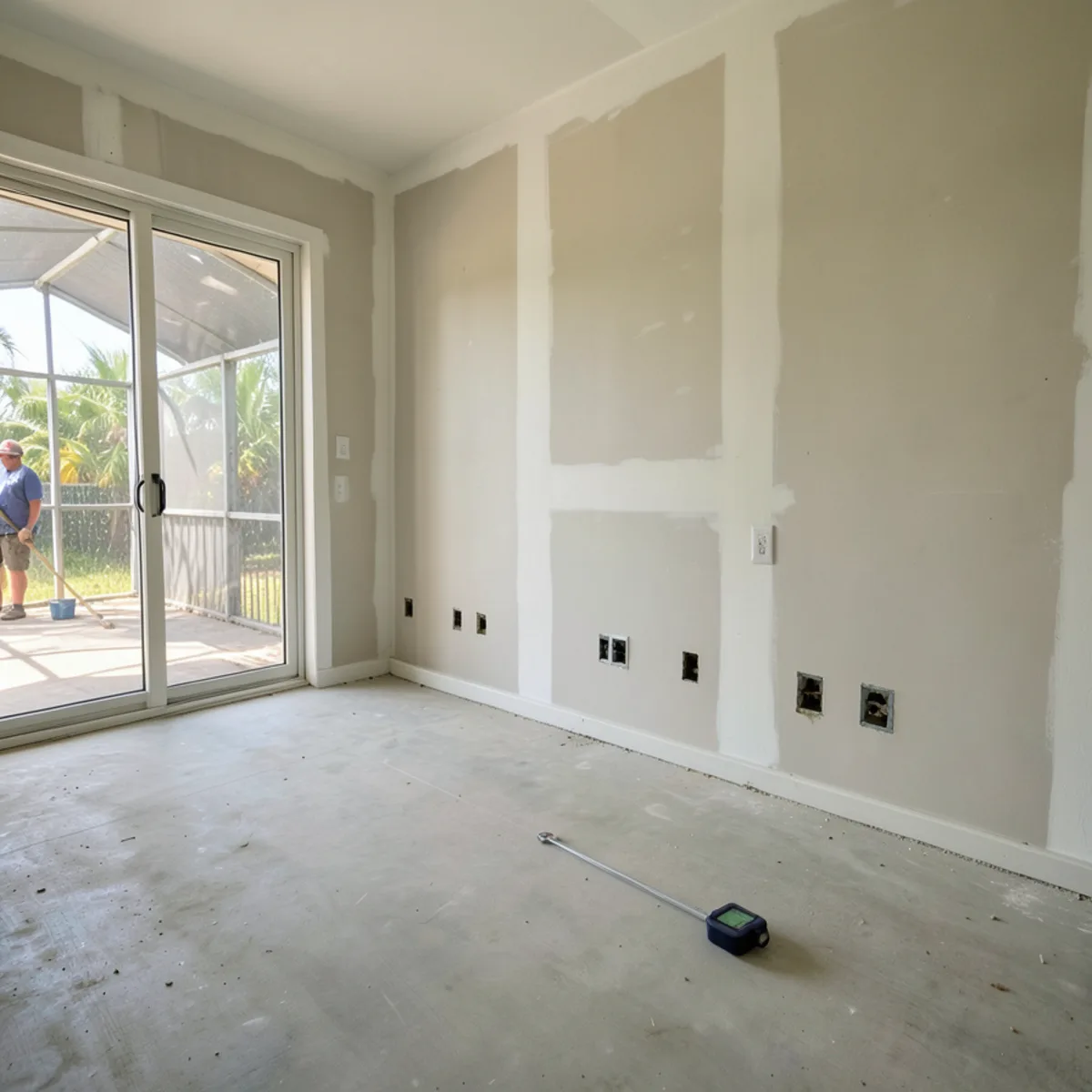
Once the room is ready, our flood-damaged kitchen cabinet replacement starts with a technical visit to measure. You can also read how the whole storm damage cabinet replacement process works, or use our checklist for judging which cabinets can be saved.
Five Rebuild Questions to Settle Before New Cabinets Are Ordered
Cabinet sizes, toe-kick heights and sink positions depend on decisions other people make. Get these answers in writing first.
| Question | Who answers it | Why it matters for cabinets |
|---|---|---|
| Is the home inside City of Sarasota limits or in unincorporated Sarasota County? | Your property record or the building department | Different offices handle permits and the 50 percent review |
| Will the repair cost trigger a substantial damage review? | The local floodplain administrator | Elevation or flood work may come before interior finishes |
| Do outlets, wiring or plumbing need repair or relocation? | A Florida-licensed electrician or plumber | Outlets, drains and supply lines fix cabinet openings |
| Is the slab being ground, patched or covered with new flooring? | Your mitigation company or general contractor | Floor height changes toe-kick and countertop height |
| What does the adjuster’s estimate include? | Your adjuster | Whether uppers are in the claim or only bases |
On the second question, the Sarasota County Property Appraiser explains that the county compares the cost of repairs with the building’s depreciated market value, and that the appraiser’s building values may be used in that calculation. City of Sarasota homes go through the city’s own permitting office.
From our design team: measuring a kitchen after a flood
After a flood we measure what is actually there, not what used to be there. Flood cuts in the drywall, a new subfloor or a slab that was ground down can all change dimensions by a fraction of an inch, and modular cabinets are built to those numbers. If the walls are still open, we note where studs, drains and supply lines sit before the drywall goes back up.
A rebuild is also the moment to rethink materials. In the 3D design we can show raised toe kicks, moisture-resistant box materials, stainless or coated hardware and open space under a sink base, so you can see each choice before anything is ordered. Photos of the kitchen before the storm help too, whether you want the old layout back or a better one.
One trade-off comes up in almost every flooded kitchen. Keeping dry upper cabinets saves money and waste, but a new base run beside older uppers rarely matches exactly, because finishes age and door profiles get discontinued. Some owners choose a deliberate contrast, such as a darker base color under the original uppers; others replace the whole kitchen. We draw both versions in 3D before you choose.
Questions readers ask
How soon after a flood can new kitchen cabinets be installed?
New cabinets can go in once the slab and walls test dry and any drywall, insulation and electrical repairs are finished and inspected. That timing depends on the house, the weather and the permit queue, not on the cabinets. We can hold the technical visit while repairs are underway, then confirm final measurements once walls are closed.
Can I keep my upper cabinets if only the base cabinets flooded?
Often, yes, if the uppers stayed dry and show no mold or swelling. The challenge is matching new base cabinets to older uppers in color, door style and finish, especially in older Sarasota homes. During the 3D design we show both options, matching new bases to the uppers or replacing the full kitchen, so you can compare them.
Is it safe to clean flooded cabinets with bleach and keep them?
The EPA advises that porous materials soaked by contaminated floodwater often cannot be cleaned well enough and may need to be discarded. Surface cleaning does not reach the inside of swollen particleboard. Solid wood or plywood boxes that dried quickly sometimes survive, but have them inspected before deciding, and keep photos and samples for your insurer first.
Should I wait for the adjuster before tearing out flooded cabinets?
Ask your insurer first, but do not let a wet kitchen sit for days. FloodSmart advises photographing damage and keeping samples of anything you must throw away for health reasons, so document every cabinet, then remove what is needed to stop mold, keeping a labeled door or panel from each run.
Do replacement cabinets have to follow the old kitchen layout?
No. Unless a substantial damage review or a plumbing limit fixes certain positions, the rebuild can use a new layout. At our technical visit we measure the stripped room, and the 3D presentation shows the old and new layouts side by side.
The bottom line
Safety, photos, samples and fast drying come first; new cabinets come last, on a dry and repaired room. Doing it in that order protects your health, your claim and the new kitchen.
When the walls are ready, call (239) 545-0550 to schedule a technical visit. We will measure the room, build the replacement plan in 3D and coordinate delivery and installation with your other trades.

Written by the FT Cabinetry design team
We design, supply and install custom modular cabinets from our Sarasota location at 2235 6th St. This guide reflects what we check at technical visits and installations; verify code and permit details with your building department. About FT Cabinetry.
Sources
- EPA: A Brief Guide to Mold, Moisture and Your Home
- EPA: Flood Cleanup to Protect Indoor Air and Your Health
- NOAA National Hurricane Center: Tropical Cyclone Report, Hurricane Milton
- NOAA National Hurricane Center: Tropical Cyclone Report, Hurricane Helene
- FEMA: Flood Insurance
- USDA FSIS: Keep Your Food Safe During Emergencies
- FloodSmart: What Flood Insurance Covers
- Sarasota County Property Appraiser: Understanding the FEMA 50% Rule
Related services
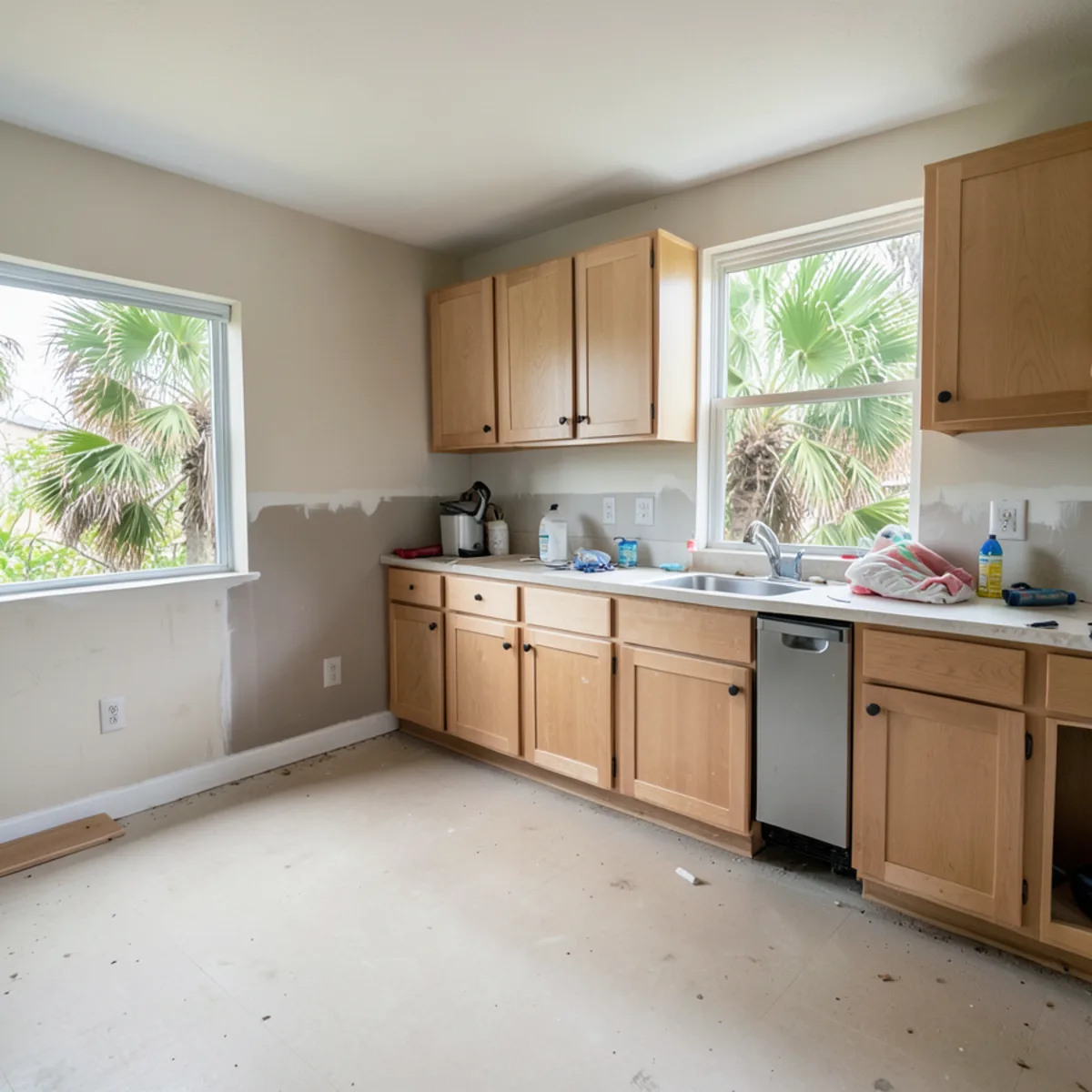
Flood-Damaged Kitchen Cabinets
Surge or floodwater in the kitchen? We measure the dried room, redesign in 3D and install new modular cabinets.
Learn more →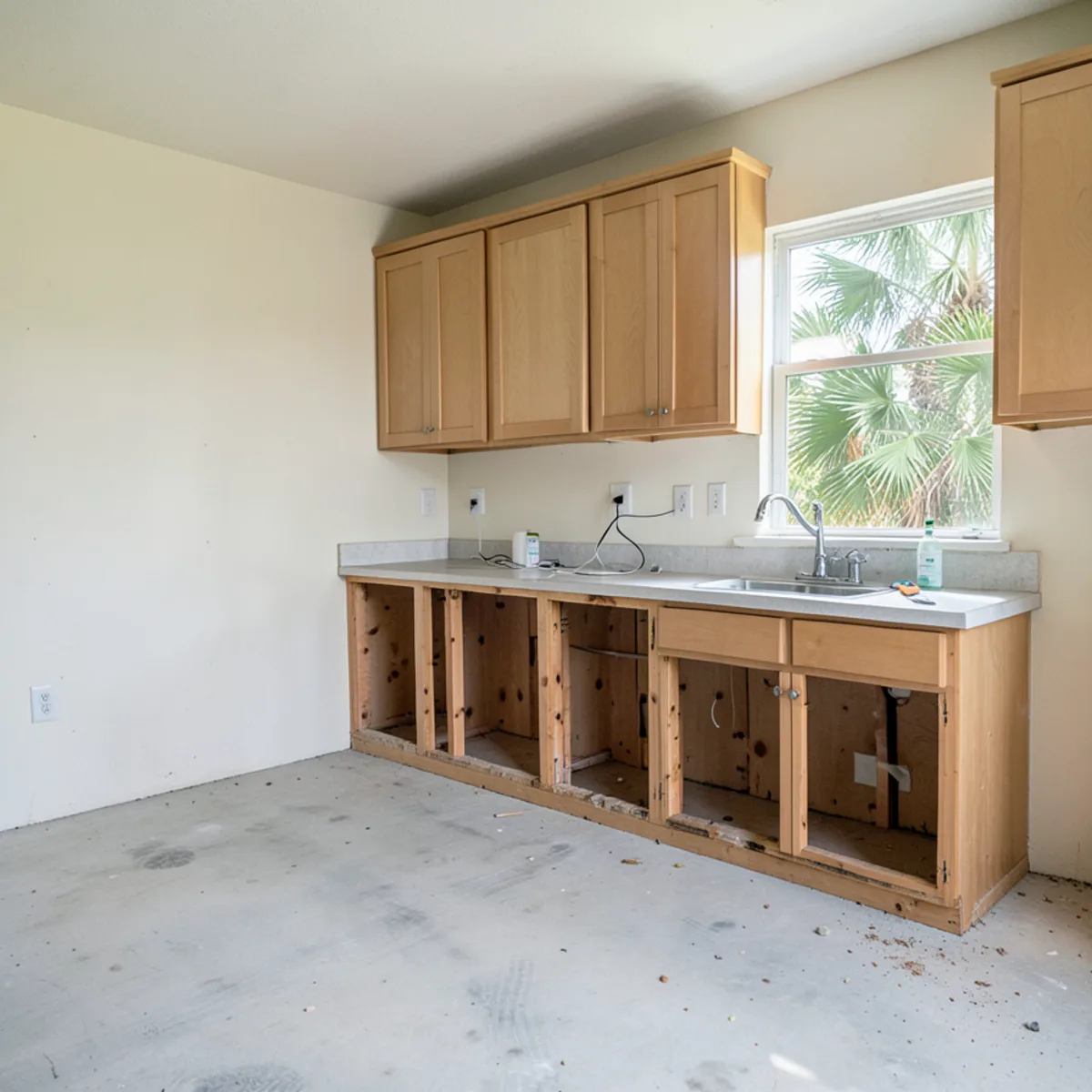
Storm Damage Cabinet Replacement
After a hurricane or flood: measured once the room is dry, redesigned in 3D and replaced with custom modular cabinets.
Learn more →Keep reading
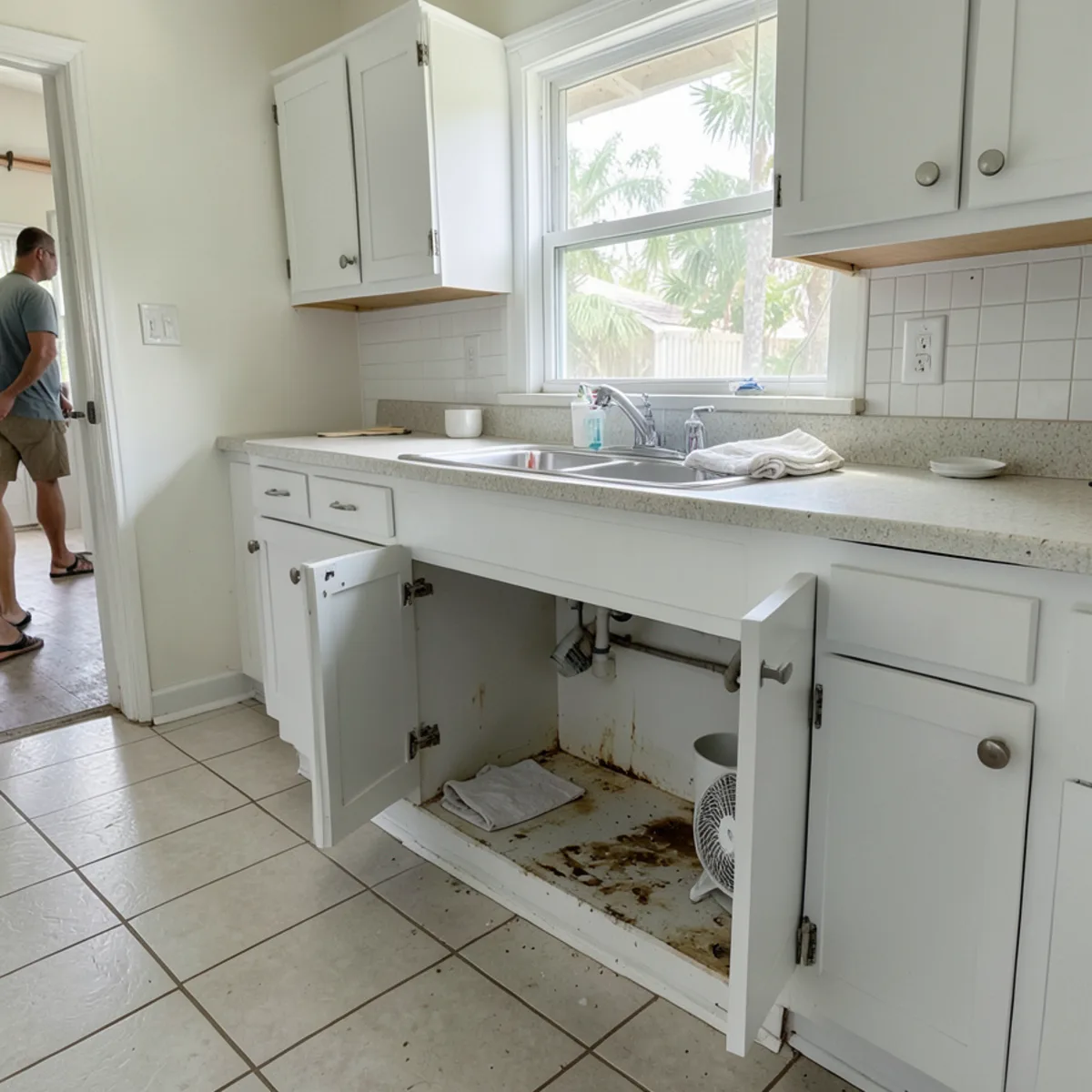
Can Water-Damaged Cabinets Be Saved? A Florida Checklist
Swollen particleboard, peeling doors and musty smells each tell you something different about whether a cabinet can stay.
Read the guide →
Hurricane Prep Checklist for Kitchens and Bathrooms
A room-by-room plan for protecting kitchen and bathroom cabinets, appliances and plumbing before a Gulf storm, so recovery starts faster.
Read the guide →